Home > General Dentistry > Teeth Whitening

Cone beam Computed Tomography

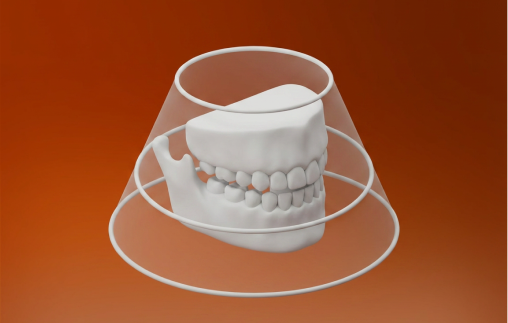
CBCT, also known as cone beam computed tomography is the advanced modality of imaging the hard tissues particularly in three dimensional assessment of the region or for the localisation of a foreign object or a transpositioned teeth. Though it's dosage is very less when compared to that of a conventional CT, it gives the necessary assessment such as the dimensions of bone in an edentulous area and the spatial relationship of structures in the area. The area of interest to be imaged determines the Field of View, further reducing the radiation by customising it for every patient.

CBCT (CONE BEAM COMPUTED TOMOGRAPHY)CBCT is the advanced version of dental imaging. It creates a 3D scan of your jaws, teeth, and surrounding structures — giving us incredibly detailed, accurate information that a regular X-ray can't provide.When do we use CBCT?
1.Implant planning: We can measure the exact height, width, and quality of bone available and see where nerves and sinuses are located — all before placing a implant.
2.Impacted or misplaced teeth: It shows us the exact position of stuck teeth or teeth that have shifted to unusual locations.
3.Complex extractions: For difficult wisdom teeth or roots near nerves or the vital structures such as the maxillary sinus, the 3D view helps us plan a safer extraction.
4.Jaw surgery: Before orthognathic surgery, we need precise measurements of your bone structure.
5.Foreign objects: If something's lodged in your jaw or sinus, CBCT helps us locate it exactly.
6.TMJ evaluation: We can assess your jaw joint in detail if you're experiencing pain or clicking.
7.Obstructive sleep apnoea: To assess the available airway space and also to monitor the presence or absense of adenoids.

What makes it different from a regular CT scan?CBCT uses much lower radiation than a conventional medical CT scan — but still gives us the 3D detail we need for dental procedures.Plus, we customize the scan area (called the Field of View) based on what we're examining. If we only need to look at one tooth, we scan just that area — further reducing your radiation exposure.How is it done?You'll sit or stand while the cone-shaped X-ray beam rotates around your head, capturing hundreds of images from different angles. The scan takes about 20–40 seconds, and a computer stitches all those images into a 3D model we can view from any angle.

Your smile is worth protecting. Schedule your visit today.

Explore More Treatments

01

Teeth Whitening

Discover our professional teeth whitening treatments that safely brighten and enhance your smile. Say goodbye to discoloration and hello to a natural, confident glow!

Wisdom Tooth Removal

Wisdom teeth, also known as third molars, are the last teeth to appear in your mouth, occurring normally 17 and...

04

Gum Treatment

Teeth whitening treatment is a simple, painless way to make your teeth whiter. Bleaching Bleaching or Teeth whitening treatment is...